
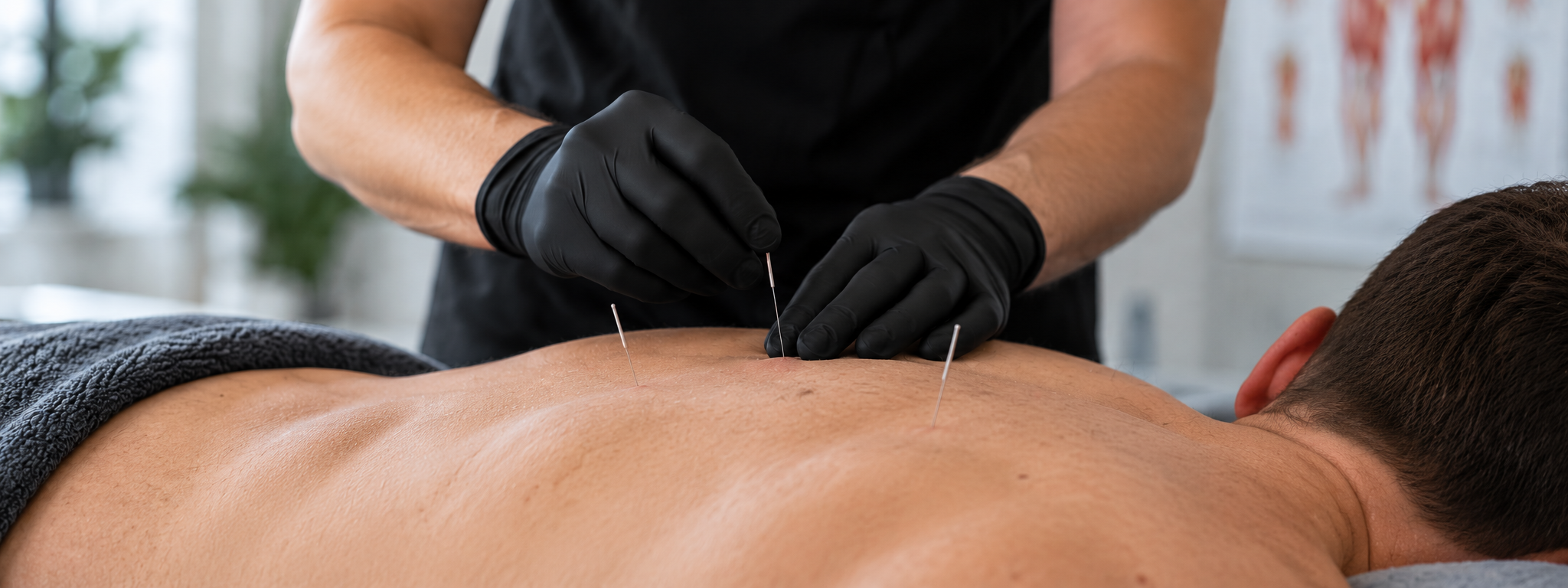
Dry Needling
A precise tool for changing pain, movement, and function.
Dry needling is a specialized physical therapy technique that uses thin, sterile filiform needles to target muscles and other tissues involved in pain and movement dysfunction. At Vital Mobility in Kalamazoo, dry needling is not used simply because a muscle is tight or painful. It is one tool within a larger clinical reasoning process designed to identify what is actually driving your symptoms and determine the most appropriate way to address it.
Dry Needling With a Purpose
Pain is not always coming from the place where you feel it. A painful or restricted muscle may be part of a larger movement, neurological, or mechanical problem.
That's why we start with a thorough assessment of your movement, strength, mobility, symptoms, and neurological system. From there, dry needling may be used when it makes sense for your specific presentation.
The goal isn't to "find the knot" and stick a needle in it.
The goal is to identify the problem, make a targeted intervention, and see whether it actually changes something that matters.
Assess. Treat. Verify.
Our approach follows a simple framework:
Assess — Identify the movement limitation, pain response, neurological finding, or functional problem that needs to change.
Treat — Use dry needling when it is an appropriate intervention for the problem. Treatment is individualized based on your presentation, irritability, tolerance, and goals.
Verify — Reassess immediately. Did your movement improve? Did your pain change? Did strength or function improve? If something changed, we use that information to guide the next step. If it didn't, we adjust our approach.
This keeps dry needling from becoming a routine procedure and makes it part of an individualized treatment strategy.
What Can Dry Needling Help With?
Dry needling may be incorporated into treatment for a variety of musculoskeletal problems, including:
Muscle pain and sensitivity
Limited mobility or range of motion
Muscle dysfunction and weakness
Sports and training-related injuries
Neck, shoulder, and back pain
Hip and lower-extremity pain
Movement restrictions
Certain chronic pain conditions
Dry needling may help decrease pain and improve movement in the short term, but the needle itself is rarely the entire solution. Research and clinical practice support using needling as part of a broader rehabilitation approach rather than replacing active treatment.
The Needle Is Only One Part of the Treatment
At Vital Mobility, dry needling is commonly paired with movement, strengthening, mobility work, education, and progressive loading.
The reason is simple: a temporary change in pain or movement is valuable—but teaching your body to maintain and use that change is what matters.
Depending on your presentation, we may use dry needling to create an opportunity for better movement, then reinforce that change with targeted exercise and functional movement.
You shouldn't need to wonder whether the treatment is working. We measure it.
Evidence-Informed. Patient-Specific. Results-Focused.
Dry needling continues to evolve as research develops. Our approach combines current evidence with clinical experience, careful assessment, patient education, and continual reassessment.
There is no predetermined set of muscles that everyone with a particular diagnosis needs needled. Your assessment determines whether dry needling is appropriate, where it may be useful, and how it fits into your overall plan of care.
The needle is a tool.
The clinical reasoning behind it is what makes it useful.